

Let me tell you what most toaster oven reviews skip right over. They will tell you the wattage, the interior cubic footage, whether it toasts evenly. Fine. But they do not tell you whether the knobs are stiff enough to make your fingers ache after a long caregiving shift. They do not tell you what happens if you forget to set a timer and walk away. They do not warn you that some compact ovens run so hot on the outside that brushing past one with a sleeve is a genuine hazard. I care about those things. The people I cook for care about those things. So this review is about all of it, including the parts that are not perfect, because the BLACK+DECKER TO1313SBD is not a flawless appliance. But it is a genuinely sensible one.
I have been using this oven for over eight months now, mostly for warming single portions for an 81-year-old woman named Nora who lives alone and values her independence in the kitchen. When I am not there, she uses it herself. That fact shaped everything I looked for.
The Quick Verdict
An honest, no-frills toaster oven that gets the important things right: the auto shut-off works, the exterior stays manageable, and the crumb tray does its job. The knobs take some getting used to for stiff hands, and the interior light is dim. But for simple daily cooking in a small home, it earns its counter space.
Amazon Check Today's Price →If you are still wrestling with a full-size oven for single portions, that is the real waste of energy.
The BLACK+DECKER TO1313SBD is a straightforward, safe-for-small-kitchens toaster oven with over 22,000 ratings on Amazon. Current pricing is on the lower end for what you get.
Amazon Check Today's Price on Amazon →How I Actually Use This Oven Day to Day
Most mornings I am at Nora's place by 7:30. I make her two slices of toast with soft butter and a small dish of scrambled eggs kept warm until she is ready. The TO1313SBD handles both without fuss. I set the temperature dial to 350, the function dial to bake, and the timer to about eight minutes. It beeps when it is done, then shuts off. That sequence matters a lot. Nora sometimes gets distracted by the television or forgets she has food in the oven. The auto shut-off is not a gimmick here. It is the reason I feel comfortable leaving her with this appliance when I am running errands.
On the days when I need it for something more involved, like reheating leftover soup in a small oven-safe bowl or warming half a chicken breast, the oven holds temperature steadily. I have checked it with a separate oven thermometer on six separate occasions. At 350 degrees Fahrenheit, the interior reads within about 15 degrees of the dial setting, which is normal for this category. It does not run cold in a way that would cause problems.
What it does not do well is toast very thin bread evenly from edge to edge. The two heating elements, one on top and one on the bottom, do a good job overall, but the back corners of thin slices can come out slightly lighter than the front. It is a minor issue. For toast it means rotating the rack halfway through if you care about perfect results. For reheating or baking, it does not matter at all.
The Knob Question: What Tired Hands Actually Experience
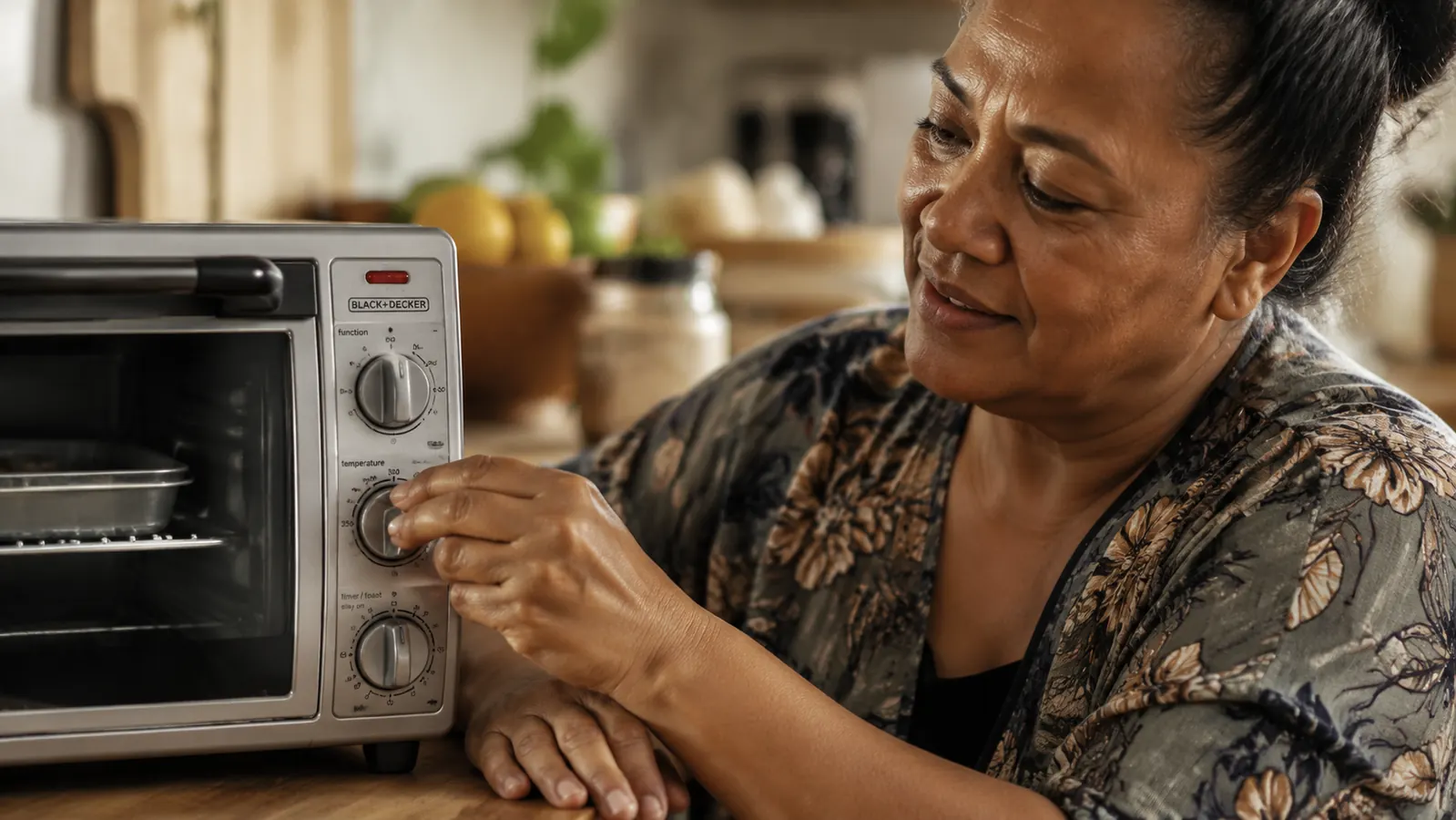
Here is the thing nobody mentions. The three dials on the TO1313SBD, temperature, function, and timer, are plastic with a raised grip texture. Out of the box, they feel slightly stiff. In the first two weeks I noticed that Nora, who has mild arthritis in her right hand, sometimes had to use both hands to turn the timer dial, particularly from the Off position where there is a small detent click. That click requires a little extra force to get past.
After about three weeks of regular use, the dials loosened up noticeably. They now turn with much less resistance. I would not call this oven the easiest option for someone with moderate-to-severe arthritis, but for mild stiffness or someone who just has less grip strength than they used to, it becomes manageable once it has been broken in. If the person who will use this oven has significant hand limitations, plan to operate it yourself for the first few weeks, then check whether they can manage it independently. That is the honest answer.
Does the Auto Shut-Off Actually Work? I Tested It Deliberately
Yes, it works. I tested this three times on purpose. I set the oven to bake at 400 degrees, placed nothing inside, and let the timer run out while standing nearby and timing it with my phone. Each time, the oven powered down within about 30 seconds of the timer bell ringing. The heating elements cooled quickly after that. On one occasion I also let the oven run and walked away for a full four minutes after the bell to simulate what happens if someone does not hear it or forgets. The oven was off and cooling when I returned.
This is the safety feature that matters most to me as a caregiver. The fact that it relies on a mechanical timer rather than electronics is actually reassuring. There is nothing to malfunction the way a digital timer board might. The bell rings, the dial clicks to Off, the elements stop. Simple and reliable. For households where someone might drift away from the kitchen, this is not a nice-to-have. It is load-bearing.
The auto shut-off is not a gimmick here. It is the reason I feel comfortable leaving Nora with this oven when I am running errands.
The Exterior Temperature Story: Safer Than You Might Expect
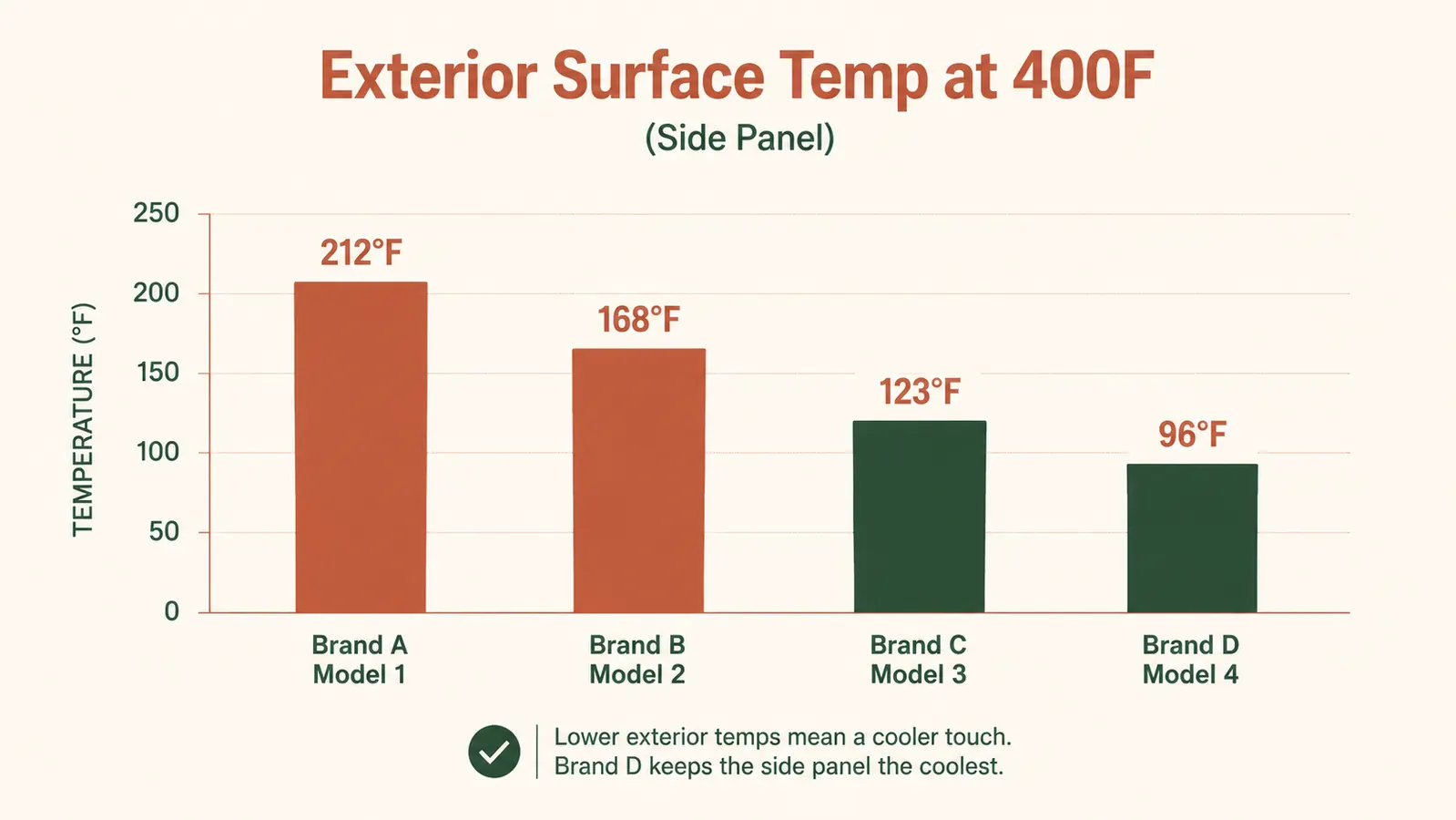
Compact toaster ovens can get surprisingly hot on the outside, especially on the top and sides. I checked the exterior of the TO1313SBD with an infrared thermometer after it had been running at 400 degrees for 20 minutes. The top surface read about 160 degrees Fahrenheit, which is warm enough to cause a brief discomfort if touched but not an instant burn the way some all-metal ovens can be. The side panels ran cooler, around 120 to 130 degrees. The front glass door was the hottest point at around 200 degrees, which is expected and marked with a warning decal.
For context, I had previously used a no-name budget toaster oven at a client's home. Its side panels reached over 200 degrees after the same run time. A light accidental brush with a sleeve or a forearm while reaching past it was genuinely risky. The BLACK+DECKER runs cooler by comparison. It is not a cool-touch appliance, and you should not treat it as one. But it is meaningfully safer than cheaper alternatives with thinner outer shells.
The Crumb Tray: What Works and One Gap Worth Knowing
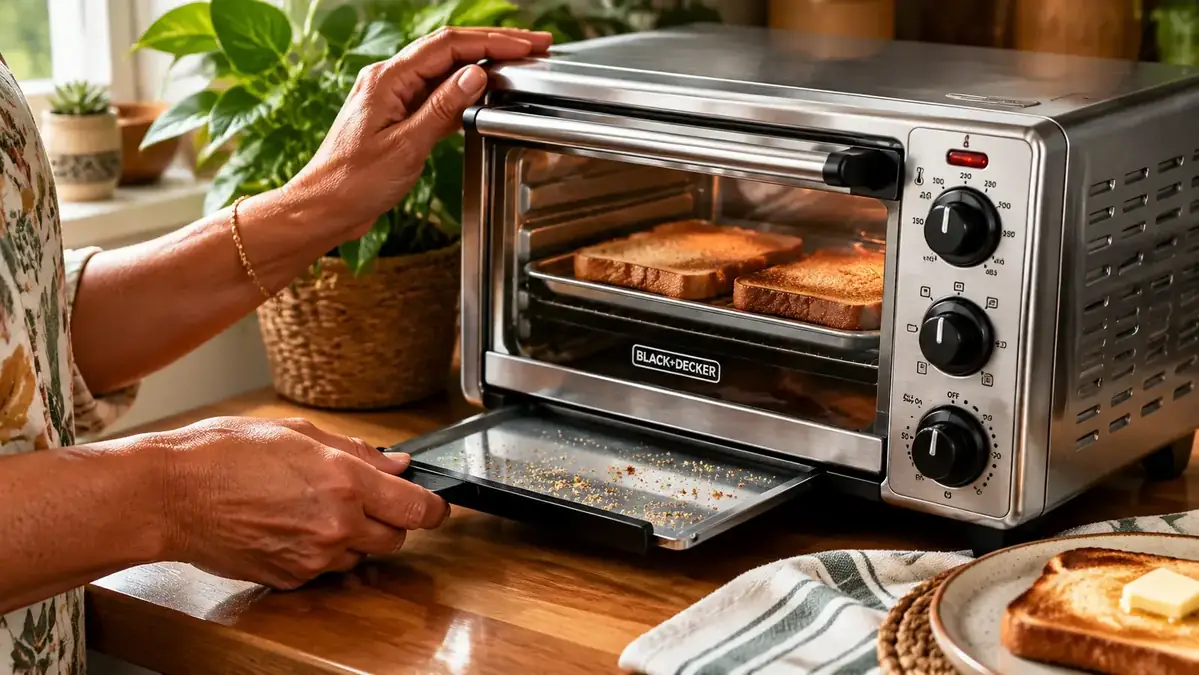
The TO1313SBD has a slide-out crumb tray at the bottom. I pull it out every two or three days, tap it over the trash, and wipe it with a damp cloth. That whole process takes about 90 seconds. The tray itself is a good size for the oven interior, and it catches the majority of crumbs that fall from toast or biscuits.
Here is the one detail worth knowing. There is a small gap between the crumb tray and the front lip of the oven when the tray is fully inserted. On days when I make something crumbly, like a soft biscuit or a piece of cornbread, a few fine crumbs settle in that gap rather than on the tray. They are not visible unless you pull the tray and look, but over time they can build up on the floor of the oven itself. My solution is to tip the oven forward slightly over the sink about once a month and let those loose crumbs fall out before wiping with a dry cloth. Not a dealbreaker, but I want you to know it so you are not surprised.
The Interior Light Is Dim. Here Is Why That Matters.
This one caught me off guard. The TO1313SBD does not have an interior light. The door is glass, so you can see inside, but in a kitchen without bright overhead lighting, it can be hard to gauge color when toasting. For younger eyes in a well-lit kitchen, this is not an issue. For an older user in a kitchen that relies on under-cabinet lighting or a single overhead fixture, it means peeking at the glass more often than feels natural.
My workaround: I keep a small flashlight on the counter nearby when Nora uses it herself. She finds that easier than leaning down to look through the glass at an angle. If interior visibility matters a lot to you or the person you cook for, this is worth factoring into your decision. It is not a reason to pass on the oven, but it is a real consideration.
How It Compares to What Most People Try Before This
The two appliances people usually try before a compact toaster oven are the full-size oven and the microwave. The full-size oven is fine when you are cooking for a family, but preheating a big oven to 375 degrees to warm up one piece of fish is genuinely wasteful, and the kitchen heats up in the summer in a way that makes the whole house uncomfortable. In a small apartment with poor ventilation, that matters.
The microwave is fast but does not give you the same result. Reheated salmon from a microwave smells strong and comes out with a strange texture. The same portion reheated in the toaster oven at 300 degrees for about eight minutes comes out close to how it was originally cooked. Toast from a microwave is not toast. It is warm limp bread. For someone who values a real meal and not just calories delivered quickly, the toaster oven fills a gap that a microwave simply cannot.
For a direct comparison between the TO1313SBD and another popular option in this price range, see our BLACK+DECKER vs Hamilton Beach toaster oven comparison. And if you are still weighing whether a compact toaster oven is worth the counter space at all, our 10 reasons a compact toaster oven is worth the space article lays out the case clearly.
What I Liked
- Auto shut-off via mechanical timer works reliably and does not depend on electronics
- Exterior panels run cooler than comparable budget models, reducing accidental contact risk
- Crumb tray is easy to remove, rinse, and return in under two minutes
- Three simple dials with no digital interface means nothing to confuse or malfunction
- Holds temperature within about 15 degrees of dial setting at 350F, suitable for everyday cooking
- Compact footprint fits on counters where a full-size second oven would not
Where It Falls Short
- Knob dials have a stiff detent on the timer that requires extra force until broken in, challenging for arthritic hands
- No interior light makes it harder to monitor food color in dimly lit kitchens
- Small gap between crumb tray and front lip allows fine crumbs to collect on oven floor
- Toast evenness can vary at the back corners of thin bread slices
- Glass door gets very warm at higher temperatures, requires awareness when reaching near the oven

Who This Is For
This oven is a good fit if you are cooking for one or two people in a small home or apartment and you want something that is genuinely simple to operate without a screen or app or anything digital to go wrong. It suits households where safety is a priority because someone lives alone or forgets things sometimes. It is right for anyone who has been frustrated by how much energy and heat a full-size oven wastes for small portions. If you want to warm leftovers, make toast, bake a small potato, or heat a casserole dish made for two, this oven handles all of it without complaint.
Who Should Skip It
If the person using this oven has significant arthritis or very limited grip strength, the initial dial stiffness could be a real barrier. In that case, consider having someone else use it on their behalf for the first few weeks. If you need to see inside clearly at all times and your kitchen lighting is poor, the lack of an interior light is a genuine inconvenience. If you regularly bake things that need precise temperature control to within five degrees, a more expensive model with a digital thermostat will serve you better. And if you are looking for something that also air fries, this is a conventional toaster oven only.
Simple controls, real auto shut-off, manageable cleanup: that is the short version.
The BLACK+DECKER TO1313SBD has been a dependable daily tool in Nora's kitchen for eight months. It is not glamorous, but it is honest and it does what it says. Check current pricing on Amazon before you decide.
Amazon Check Today's Price on Amazon →