

When I started looking at single-serve coffee makers, I read a lot of reviews. Most of them told me the same things: small footprint, easy to use, brews fast. Those things are all true about the Keurig K-Mini. But after using this machine regularly while caring for a client, and talking to a handful of other women who cook for one or two people, I noticed a gap between what reviews cover and what actually comes up once you own it. This is my attempt to fill that gap.
I am not going to walk you through the full long-term use story here. I covered that in the Keurig K-Mini long-term review. What I want to do in this piece is go through the specific things that surprised me, that other people warned me about after the fact, and that I think you deserve to know before you hand over your money. If you are already comparing it to another machine, the Keurig K-Mini vs Nespresso Vertuo Pop comparison covers that side of the decision.
The Quick Verdict
For a one-cup-a-day person with a small kitchen and no patience for complicated machines, the K-Mini is genuinely good. The honest catches: pod costs add up more than most reviews admit, it is louder than it looks, and if you ever want two cups in a row you will feel the friction. None of that makes it a bad buy for the right person. It just means you should go in with clear eyes.
Amazon Check Today's Price →You keep brewing a full pot and pouring half of it down the drain. The K-Mini fixes that problem, and nothing else.
It is sized for exactly one cup, which is either perfect for you or a reason to keep looking. Worth checking today's price before you decide.
Amazon Check Today's Price on Amazon →The Noise Level Nobody Mentions
The K-Mini is not silent. That sounds obvious, but I did not find a single review that told me what to actually expect. When it is heating the water, it makes a low gurgling hum. When it starts pumping water through the pod, there is a louder pressurized pushing sound, somewhere between a coffee shop machine and a standard drip coffee maker. It is not alarming and it is not a grinding industrial noise, but it is also not background noise.
In my experience, the loudest part lasts about 30 to 45 seconds while the water is moving through the K-Cup. If you are in a studio apartment where the sleeping and living area share the same walls, the person still in bed will probably hear it. I have asked a few people about this specifically, and the answers split about half and half. Some said their partner slept through it. Others said it was enough to prompt a request to wait until they were already awake. If noise is a real concern for your household, that is worth factoring in. The machine is not marketed as quiet, but it is also not listed as noisy. You are just expected to know.
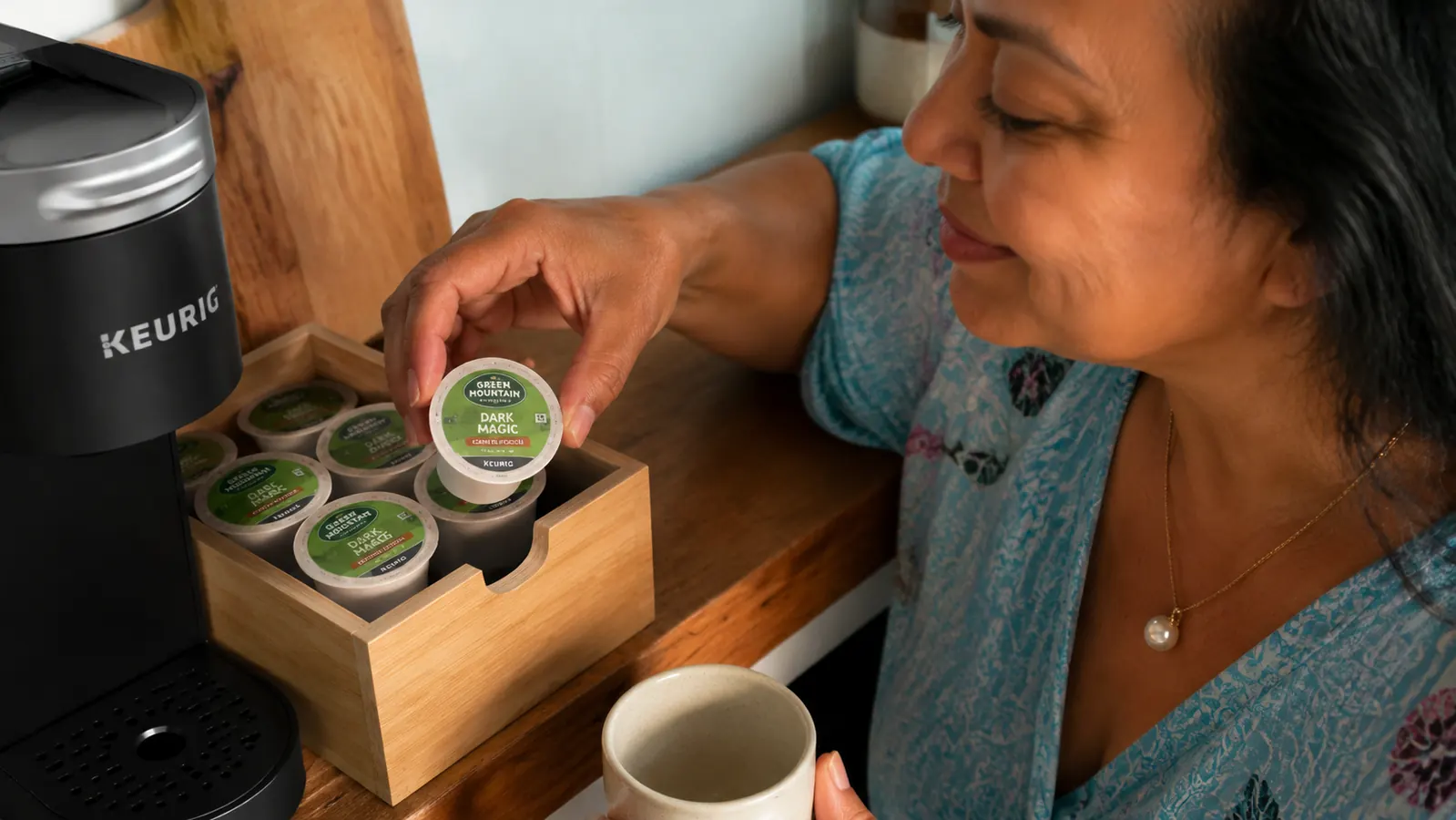
What the Pod Aisle Actually Costs You
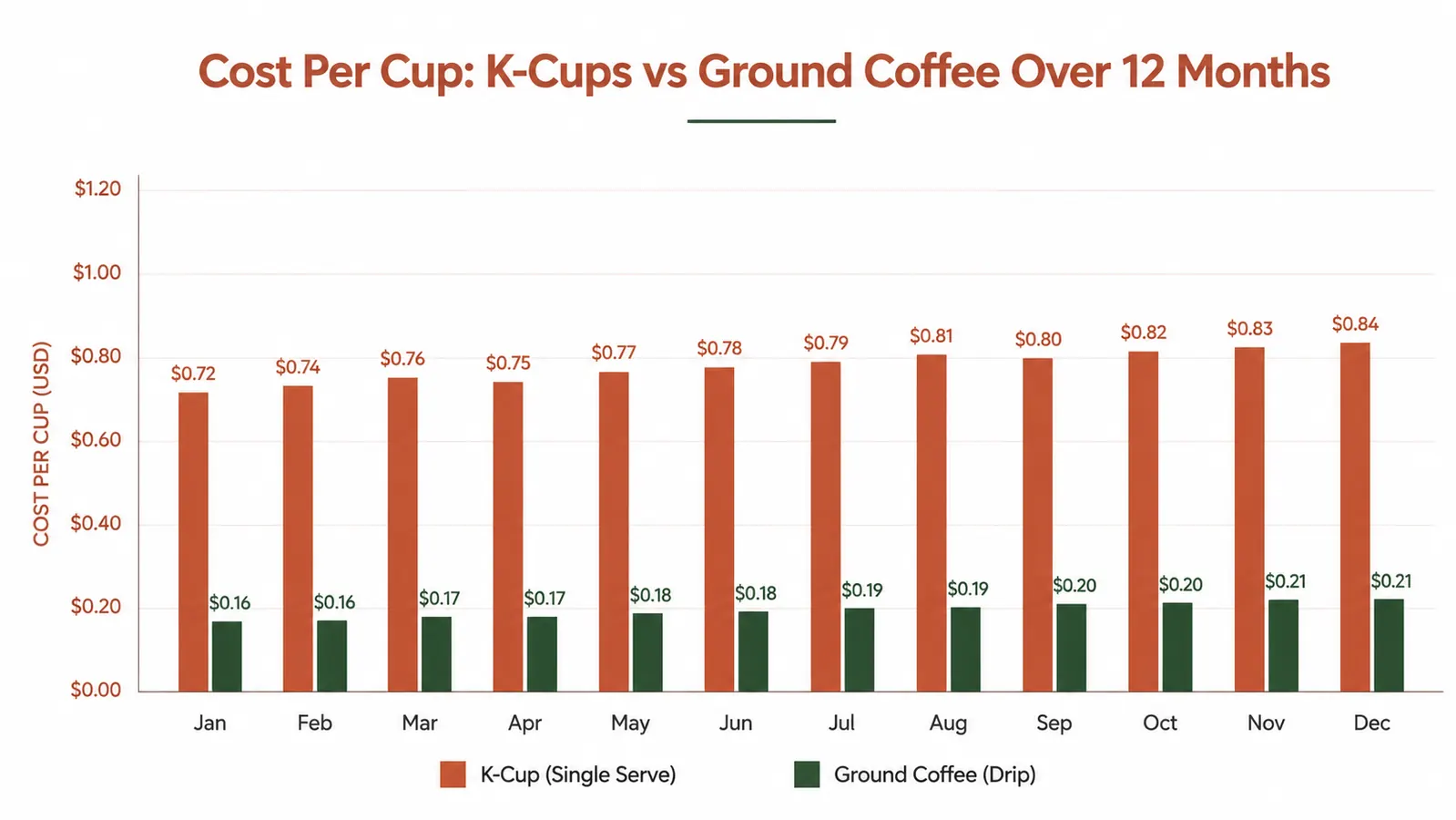
Here is the math that took me a little too long to do before buying. A box of 32 K-Cup pods from a mainstream brand runs in the mid range, depending on the variety and where you buy. That works out to budget-friendly per cup. A standard 12-ounce bag of medium-roast ground coffee brews somewhere between 15 and 18 cups and costs in the low-to-mid range, which puts you at a moderate cost per cup at the low end and closer to the higher end of moderate at the upper end.
Wait, that looks like pods are cheaper. Not quite. The comparison gets tricky because ground coffee prices vary widely, and premium pod brands push the per-cup cost up significantly. Specialty pods from smaller roasters that are only sold in single-serve format often run at premium prices each. If you pick your pods from the budget section of the store, you will be close to ground coffee costs. If you want a specific roast or brand, the premium adds up quickly over 365 cups a year. I want you to see that math before you buy rather than after.
The convenience is real. There is no measuring, no mess, no filter to buy. Whether that is worth the potential cost difference is something only you can decide. But I think more reviews should show the numbers plainly instead of just saying pods are convenient.
The Pod Variety Trap
One thing I did not fully anticipate: the first month with a pod machine is genuinely fun. There are hundreds of K-Cup varieties across dozens of brands and roast levels. You try a few, you find a couple you like, and then you keep buying them. The trap is that some of the pods you end up loving are only sold in packs of 12 or 18 rather than 24 or 48, so the per-cup cost on those smaller boxes is significantly higher. And once you find a coffee you really like, it can feel wasteful to order a variety pack just to use half of it.
I have settled on one regular pod I buy in bulk and one occasional variety I pick up when I see it. That system works fine. The point I want to make is that the K-Mini opens a door to a category of spending that is easy to let get out of hand if you are not paying attention. Set a rough pod budget in your head before you start experimenting and you will be fine.
The first month with a pod machine is fun. The varieties are endless. Have a budget in mind before you start, or the convenience can quietly cost you more than you planned.
The Drip Tray: Smaller Than You Think, and One Useful Trick
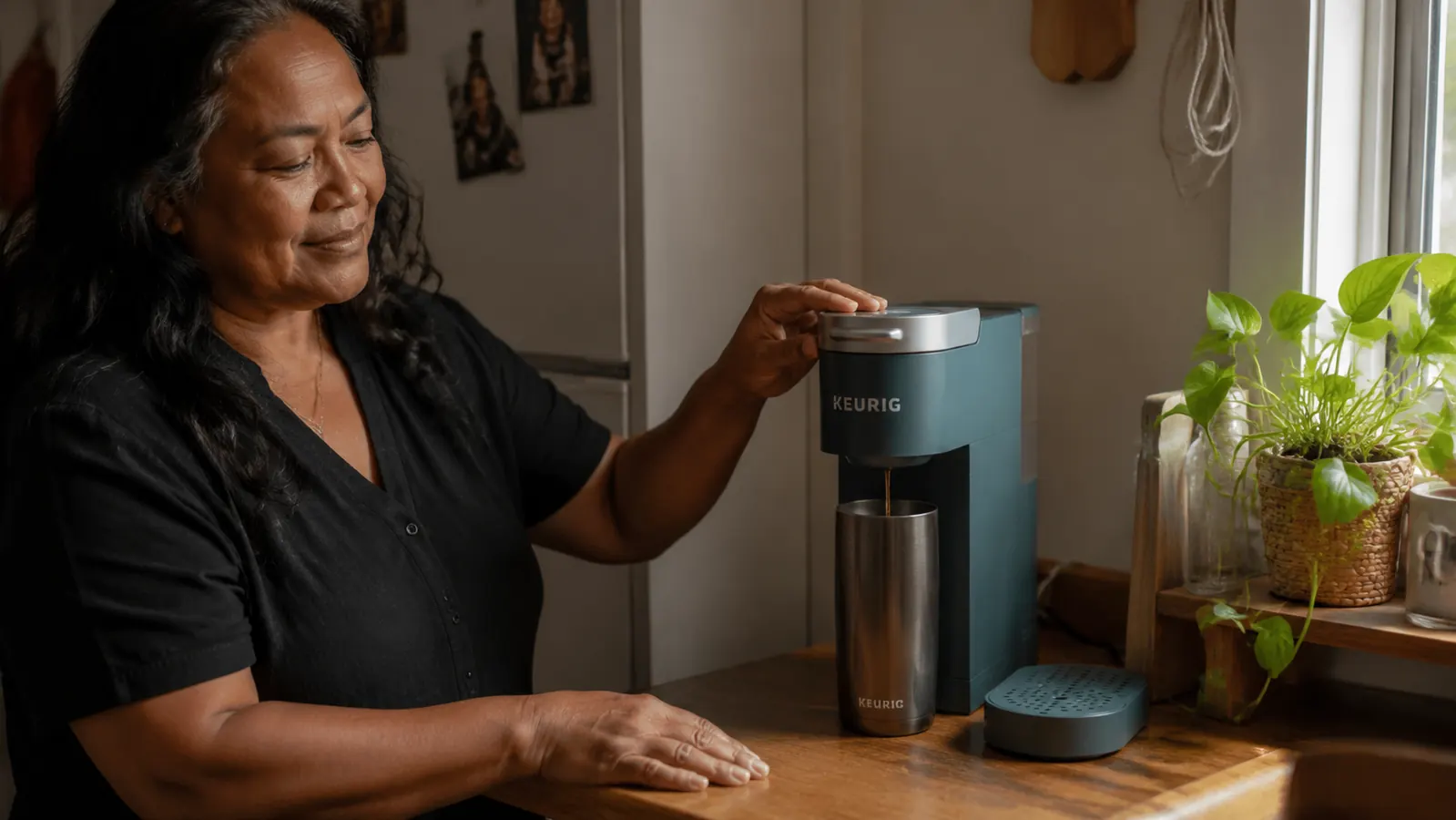
The drip tray underneath the brew spout is small, and it fills up faster than you might expect if any drips escape your mug. I empty mine every few days. It slides out cleanly and is easy to rinse in the sink, so this is not a complaint, just something to know. More useful is what the drip tray does when you remove it entirely: it gives you extra vertical clearance under the spout.
Without the drip tray, many medium-height travel mugs fit beneath the brew head where they would not fit with the tray in place. You lose the drip protection when you do this, so if the last bit of your brew drips after you move the mug you will get a few drops on the counter. I keep a small folded paper towel on the counter when I do this. It is a minor workaround but one I wish someone had told me about earlier. Standard ceramic mugs fit with the tray in place with no issue.
Using It at Someone Else's Home
I spend three mornings a week caring for an 81-year-old woman named Clara, and she has a Keurig K-Mini Plus in her kitchen. The K-Mini and the K-Mini Plus are nearly identical in footprint and operation, and the pods are the same. Because I was already familiar with the controls from using my own machine, setting up Clara's coffee in the morning is completely effortless. I do not have to read anything or hunt for buttons. That kind of cross-household familiarity is something I did not think about as a benefit before I owned one.
Clara can operate hers on her own on the mornings I am not there. She is 81, has mild arthritis, and manages the lid and the reservoir fill without assistance on most days. She uses both hands to close the lid, which takes one firm push, and she fills the reservoir at the sink with a small pitcher so she does not have to carry the unit to the sink. That small adaptation made the whole process comfortable for her. If you are buying for someone with limited hand strength, the two-handed lid close and the reservoir fill are the two things to think through in advance.
Where the K-Mini Falls Short: The Two-Cup Morning
The K-Mini is built around one cup. The reservoir holds just enough water for a single brew, so if you want a second cup you are refilling the reservoir and restarting the heating cycle. That adds time. It is not a long wait, maybe two to three minutes, but it is also not a seamless experience. If your normal morning includes two cups, or if you are ever cooking for a spouse or partner who also drinks coffee, you will feel this limitation every single day.
The machine is not built for that use case and does not pretend to be. A 12-cup drip machine or even a slightly larger single-serve unit with a bigger reservoir would serve a two-cup household better. I want to say this plainly because I have heard from people who bought the K-Mini thinking they would just run it twice and found the friction annoying after a few weeks. If you are a single-cup person, that is not a problem at all. But know where you land before you buy.
The Auto Shut-Off and Why It Matters More Than You Think
The K-Mini shuts itself off about 90 seconds after it finishes brewing. I want to give this feature more space than most reviews do, because for someone like me, who is often rushing out the door with a lot on her mind, this is not a minor convenience. It is a genuine safety feature that removes a category of worry from my morning.
A carafe machine that stays hot for hours is a machine you have to remember to turn off. With the K-Mini, I do not have to remember. I grab my cup, I head out, and I know the machine has already powered down on its own. I have cared for people in homes where leaving a hot appliance running unattended was a real safety concern. Having that shutdown built in automatically, with no timer to set and no button to press, matters in ways that go beyond convenience. It is one of the details that made me confident recommending this machine to Clara's family.
What I Liked
- Auto shut-off 90 seconds after brewing, no timer to set, no button to press
- Genuinely small footprint, about five inches wide, fits in tight countertop spots where other machines do not
- Two-button controls with no screen or app, straightforward enough for anyone to learn in one use
- Works with any K-Cup brand, not locked to Keurig-only pods
- Drip tray removes easily to accommodate medium travel mugs with a simple workaround
- Consistent brew temperature and speed across dozens of cycles without maintenance surprises
- Good cross-household familiarity if you or a family member also has a Keurig at another home
Where It Falls Short
- Noticeably loud during the water-pumping phase, about 30 to 45 seconds of pressurized sound
- Pod cost adds up faster than budget drip coffee, especially with premium or specialty varieties
- Single-cup reservoir means a second cup requires a full reservoir refill and reheat cycle
- Lid requires a firm deliberate close that works best with two hands for people with limited grip
- Pod variety is tempting and can lead to higher spending if you experiment without a budget in mind
- Drip tray is small and needs emptying every few days if any liquid misses the mug

Who This Is For
The K-Mini is a strong match if you brew one cup a day, live alone or with one other person who is not a coffee drinker, have a tight counter situation, and want a machine that does not ask anything complicated of you. It is also a good fit if you or someone you care for benefits from an auto shut-off, since that feature is genuinely more useful than it sounds at first. If you value the freedom to try different pods rather than committing to a bag of ground coffee, the K-Cup format gives you that without wasting most of a bag.
Who Should Skip It
Skip it if you drink more than one cup most mornings. Skip it if noise before 7 AM is a real concern in your home. Skip it if your budget is tight and you want to keep coffee costs as low as possible, since a basic drip machine and a bag of ground coffee will cost you less per cup over time. And skip it if you have significant grip or hand strength limitations that make a firm one-push lid close uncomfortable. There are machines with simpler loading mechanisms that might work better in that situation.
None of those are criticisms of the K-Mini itself. They are just honest descriptions of where it is not the right tool. The machine does what it promises for the person it was designed for. The goal of this review is to help you figure out whether that person is you.
If one cup a day is your whole coffee life, the K-Mini is a genuinely good machine for a genuinely reasonable price.
It is small, simple, and it shuts itself off. For a small kitchen and an uncomplicated morning, that is a lot to like. Check today's price on Amazon and see if it fits your budget.
Amazon Check Today's Price on Amazon →